
Introduction
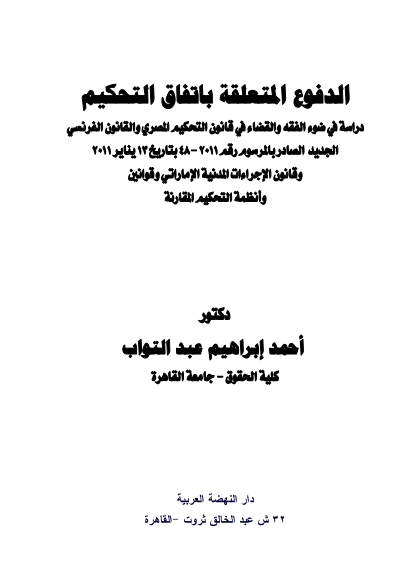
The document examines the legal defenses associated with arbitration agreements, a critical aspect of arbitration law that governs the resolution of disputes outside traditional court systems. Arbitration agreements are contractual arrangements where parties agree to resolve disputes through arbitration rather than litigation. Defenses related to these agreements often arise when one party challenges the validity, enforceability, or scope of the agreement, or when procedural issues affect the arbitration process. The text appears to be a detailed legal analysis, likely intended for scholars, practitioners, or students of arbitration law, and draws on comparative legal perspectives, including references to Egyptian, French, and international arbitration frameworks.
Key Themes and Structure
The document is organized into several sections, each addressing specific defenses or procedural aspects of arbitration agreements. The following key themes emerge from the available content:
- Nature and Validity of Arbitration Agreements: The text discusses the legal requirements for a valid arbitration agreement, including consent, capacity, and the subject matter's arbitrability.
- Jurisdiction of Arbitral Tribunals vs. Courts: It explores the division of authority between arbitral tribunals and national courts in addressing defenses related to arbitration agreements.
- Defenses Against Arbitration Agreements: These include defenses based on the absence, invalidity, or termination of the arbitration agreement, as well as procedural objections.
- Procedural Aspects of Arbitration: The document covers procedural rules governing arbitration, including the role of courts in reviewing arbitration agreements and awards.
- Comparative Legal Analysis: References to Egyptian law, French law (e.g., NPCP articles), and international arbitration practices indicate a comparative approach.
Chapter Summaries
The document is divided into multiple sections (referred to as "المطلب" or "الفرع"), each addressing specific aspects of arbitration defenses. Below is a summary of the key points based on the available text:
1. Defenses Based on the Existence of an Arbitration Agreement
The document begins by discussing defenses rooted in the existence or non-existence of an arbitration agreement. A key defense is the claim that no valid arbitration agreement exists due to lack of consent, improper formation, or non-compliance with legal formalities (e.g., written form). The text references Egyptian law, which requires arbitration agreements to be in writing and clearly express the parties' intent to arbitrate (Page 9, 11, 12). It also cites international sources, such as the New York Convention, which emphasizes the need for a written agreement.
- Legal Requirements: The arbitration agreement must meet specific criteria, including mutual consent, capacity of the parties, and a defined subject matter suitable for arbitration.
- Challenges to Existence: A party may argue that the agreement was never formed due to fraud, coercion, or mistake, or that it does not cover the dispute in question.
- Court's Role: Courts have the authority to determine whether an arbitration agreement exists before referring a case to arbitration (Page 55, 79).
2. Defenses Based on Invalidity or Nullity
Another major defense is the invalidity of the arbitration agreement, which may arise due to legal defects such as lack of capacity, violation of public policy, or non-arbitrability of the subject matter. The document cites cases where courts have ruled on the nullity of arbitration agreements due to these issues (Page 25, 35, 79).
- Capacity: Parties must have the legal capacity to enter into an arbitration agreement. For example, minors or entities without proper authorization may render the agreement void.
- Public Policy: Disputes involving matters of public policy (e.g., criminal law or certain family law issues) are generally non-arbitrable.
- Formal Defects: Failure to adhere to statutory requirements, such as written form or specificity, can invalidate the agreement.
3. Defenses Based on Termination or Expiration
The document discusses defenses claiming that the arbitration agreement has terminated or expired, rendering it unenforceable (Page 139, 182, 219). Termination may occur due to:
- Expiration of Time Limits: Some arbitration agreements include time limits for initiating arbitration, and failure to comply may lead to termination.
- Mutual Agreement: Parties may mutually agree to terminate the arbitration agreement.
- Fulfillment of Purpose: If the dispute for which the agreement was made has been resolved, the agreement may no longer apply.
4. Jurisdiction of Arbitral Tribunals
A significant portion of the document addresses the authority of arbitral tribunals to rule on their own jurisdiction, a principle known as "competence-competence" (Page 183, 243, 251). This principle allows arbitrators to determine whether they have jurisdiction over a dispute, including the validity of the arbitration agreement.
- Competence-Competence: Arbitral tribunals can assess the existence, validity, and scope of the arbitration agreement before proceeding with the case (Page 243).
- Court Review: Courts may intervene to review jurisdictional decisions, particularly if a party challenges the tribunal's authority (Page 153, 159).
- Negative Effect of Competence-Competence: Courts must refrain from hearing disputes covered by a valid arbitration agreement unless the agreement is manifestly void (Page 116, 161).
5. Procedural Defenses
The document also covers procedural defenses, such as objections to the arbitration process or the conduct of the arbitral tribunal (Page 204, 211). These include:
- Procedural Irregularities: Failure to follow agreed-upon procedures, such as improper notification or selection of arbitrators, can be grounds for challenging the arbitration.
- Waiver of Rights: A party may lose the right to raise certain defenses if they participate in the arbitration without objection (Page 219).
- Time Limits: Defenses must be raised within specific timeframes, as outlined in applicable arbitration laws (Page 275).
6. Comparative Legal Perspectives
The text frequently references Egyptian arbitration law, particularly the Egyptian Arbitration Law No. 27 of 1994, and compares it with French law (e.g., Articles 1466 and 1488 of the NPCP) and international arbitration standards (Page 77, 94, 101). It also cites scholarly works by authors such as Jean Vincent, Pierre Jullien, and Natalie Fricero, indicating a reliance on both Arabic and Western legal scholarship (Page 298, 299).
- Egyptian Law: Emphasizes the autonomy of arbitration agreements and the limited role of courts in interfering with arbitral proceedings.
- French Law: Provides a framework for the competence-competence principle and the procedural requirements for arbitration agreements.
- International Standards: References to the New York Convention and UNCITRAL Model Law highlight the global context of arbitration defenses.
7. Practical Implications
The document discusses the practical implications of raising defenses in arbitration, including the impact on the arbitration process and the finality of arbitral awards (Page 247, 260). Key points include:
- Burden of Proof: The party raising a defense (e.g., invalidity or non-existence of the agreement) bears the burden of proving their claim.
- Judicial Review: Courts may review arbitral awards for procedural fairness or compliance with public policy, but their scope of review is limited (Page 149, 150).
- Enforcement: Valid arbitration agreements and awards are enforceable under national and international law, provided no valid defenses are upheld.
Critical Analysis
The document provides a thorough examination of arbitration defenses, supported by legal provisions, case law, and scholarly references. However, the fragmented nature of the OCR text limits the ability to fully reconstruct the arguments. The text's reliance on Egyptian and French law suggests a focus on civil law jurisdictions, which may limit its applicability to common law systems. Additionally, the document's academic tone and dense legal analysis make it more suitable for legal professionals than lay readers.
Conclusion
The document "الدفوع المتعلقة باتفاق التحكيم" offers a detailed exploration of defenses related to arbitration agreements, covering their existence, validity, termination, and procedural aspects. It emphasizes the autonomy of arbitral tribunals, the limited role of courts, and the importance of adhering to legal formalities. By drawing on Egyptian, French, and international legal frameworks, the text provides a robust comparative analysis, making it a valuable resource for understanding arbitration law in civil law jurisdictions.
References
The document cites numerous sources, including:
- Egyptian Arbitration Law No. 27 of 1994.
- French Code of Civil Procedure (NPCP), Articles 1466, 1488.
- Scholarly works by Dr. Ahmed Ibrahim, Jean Vincent, Pierre Jullien, Natalie Fricero, and others.
- International conventions, such as the New York Convention.